

a walnut
Chapter One of Cosmic Heart

In September 2024, I sent the first installment of Cosmic Heart to my paid subscribers and posted the twelfth installment in August 2025. After a nine-month break, I’ve returned to the project, and I’m releasing these revised chapters free for everyone.
Cosmic Heart
Chapter One
It was November 2016. My partner Tracy and I went to our polling place—the basement of a church near a university campus—to vote in the presidential election. It was misty and overcast. I was nervous about the election and leaned into everyone who said, “Don’t worry.” I leaned into the fact that Clinton was ahead in the polls. “First woman president,” people said, and I hoped they were right. Surely they were right, and the sinking feeling in my solar plexus was wrong.
We waited in line and cast our votes.
When we came back outside, there was a low, thick fog on the ground. As we crossed the street to go back to our car, a deer came running down the sidewalk. She was terrified, her hooves hitting the concrete. I had never seen a deer in town. How did she get there? Where would she end up? We stood there, our hearts racing, as she disappeared back into the mist.
That night, our neighbors were hosting an election watch party. We took our dogs out before heading over. As I watched Rocky walk through the monkey grass in front of our house, I heard a clear, unemotional voice speak inside my head.
“He wins,” the voice said.
When my mother was ten years old, she decided to go to church. Neither of her parents was religious. My grandfather would later have a conversion experience, which he never spoke about, and become a devout Christian, but that had not yet happened. My mother decided to go to church on her own. She arranged for a neighbor to pick her up on Sunday mornings, and my grandmother gave her a coin to put in the collection plate.
Soon after she started attending, the church learned that my mother could play the piano, and that is how she became a church musician, first playing the piano and then the organ at Red House Baptist.
Both of my parents grew up in rural Kentucky, my mother in the central part of the state, my father in the mountains of the eastern part. He, too, attended a Baptist church, but it wasn’t of his own volition. As a child, my father found church to be hot, insufferably long, and frightening.
Married while they were in college, my parents moved from a small town in Kentucky to a small town in Missouri for graduate school. It was there that they saw women wearing jeans for the first time. It was there that they saw real hippies for the first time. Vigils and protests. Graduate school broadened their peer group and their horizons.
By the time I was born, they had made the switch, which seemed radical to them at the time, from the Baptists to the Methodists. I was christened as an infant in the Methodist Church, as was my brother. We were back in Kentucky by that time, living in Frankfort, where my father had taken a job at the State Department of Education.
I remember our church in Frankfort as a warm and sunny place, and when my family moved back to Richmond, we moved our attendance to the United Methodist Church there, one of three large buildings that faced one another on Main Street.
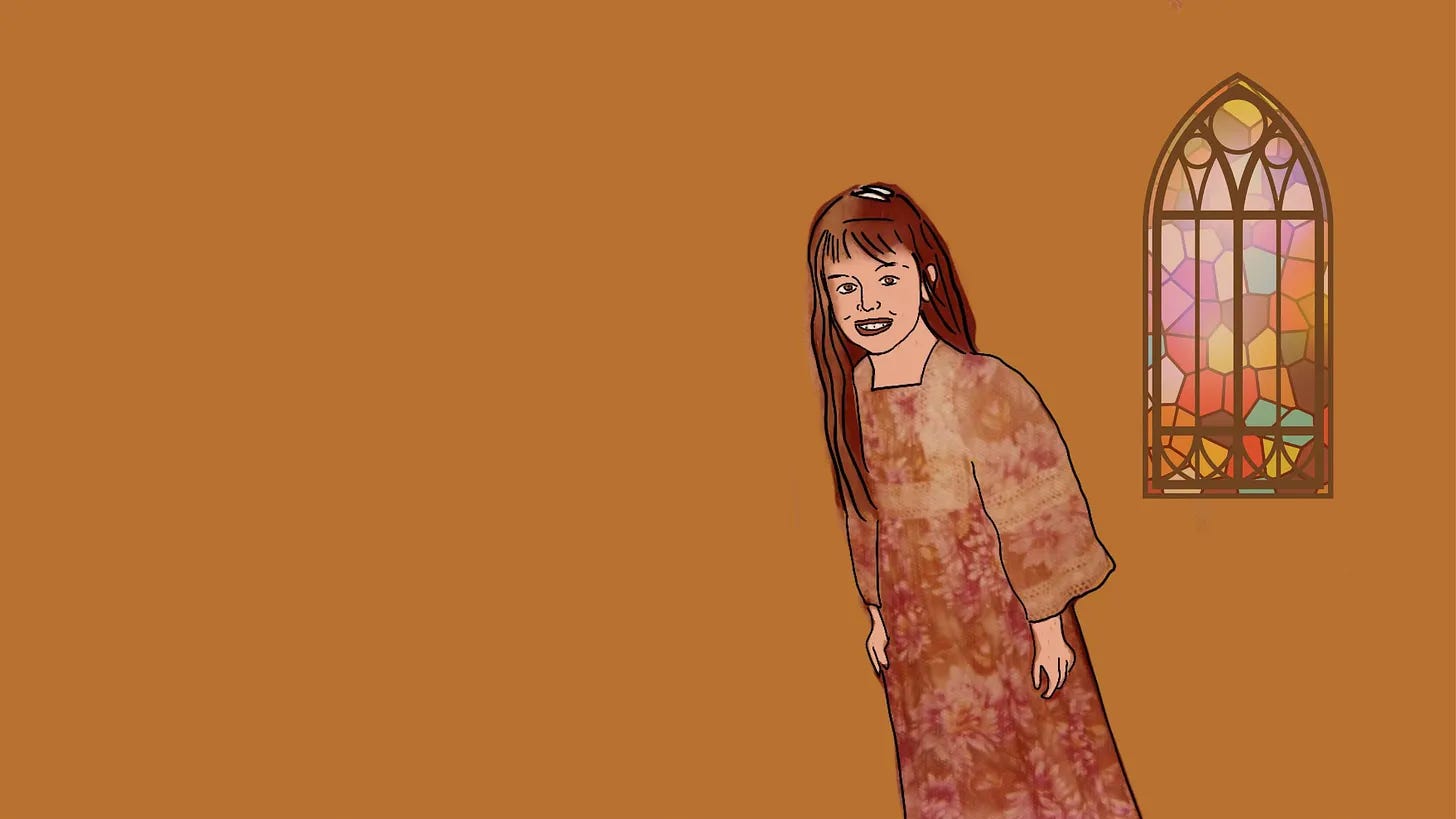
My parents were friends with the minister, who rode a motorcycle and wore a leather jacket. I was a flower girl at his daughter’s wedding. My grandmother made the dress I wore, a silky floral pattern with butterfly sleeves. I remember standing in the vestibule before the wedding with the bridesmaids, understanding the importance of the moment. I took my flower girl duties seriously. I don’t remember, but I was told that instead of tossing handfuls of flower petals as I walked down the aisle, I meticulously plucked one rose petal at a time from my basket and dropped it ceremoniously onto the burgundy carpet.
My early childhood memories of church are pleasant. Even after a change in leadership and a new minister my parents did not like at all, I remember church as a place with good food, crafts to make, and music that was fun to sing. I do remember once sitting in a Sunday school classroom listening to the teacher tell us a story that I did not believe to be true. I remember thinking that even though this woman meant well, she was wrong. I looked past her to the dust motes dancing in the sunbeam streaming through the window, biding my time.
My mother, though she didn’t have a permanent position, was still a church organist and often filled in for other organists when they needed a substitute. That is how she came to play at the Episcopal Church. My Brownie troop met in the basement of that church. While the Methodist church was all pastels, the Episcopal Church was dark and serious—the right atmosphere, we felt, for the game we played while waiting for our parents to pick us up. One at a time, we slipped into the bathroom and turned in circles, chanting Bloody Mary three times, then stood at the mirror, waiting for her to appear—the ghost of Queen Mary. I never saw her, but I stood there in the dark of the church with my heart hammering, turning, chanting, and looking.
My mother was nervous about playing the complicated service, but the moment it started, she had a conversion experience of her own. She says it felt like a homecoming. She found, at last, what she’d been searching for when she first took herself to church at the age of ten. She was an Episcopalian.
The organist at the Episcopal Church followed the priest when he left to lead a new congregation in the neighboring county. A small historic church, surrounded by thoroughbred farms, had been restored and would house an interdenominational congregation included in both the Episcopal diocese and the presbytery.
The organist asked my mother to sub for her not long after making the move, but never returned, and my mother became the full-time organist for Walnut Hill when I was six or seven. The stone church was built in 1801. Once it had fallen into disrepair and been used by a neighboring farmer to store hay. When the building was renovated, the balcony where enslaved people were once forced to sit was closed off. I remember wondering if this was done out of respect or erasure, and I still don’t know.
The sanctuary was plain but elegant with minimalist stained glass windows. The pews were grey wood. The prayer book was an Episcopal-Presbyterian hybrid, but the priest was Episcopalian.
And so, my family began to get up and dress on Sunday mornings and drive to Fayette County for church. There was no Sunday School at Walnut Hill, but there was a coffee hour with cookies, and after church, we would often go on to Lexington, where we would eat lunch at the Oriental Inn and browse the shops in the mall. We looked at records and books. My dad would go to the pipe store for sweet-smelling tobacco.
Once, a friend asked my brother what denomination we were, and he answered, “Walnuts.”
So early in life, I was a Walnut, but I also visited churches with my friends, sang in their choirs, and spent the night at their lock-ins. I even went to Vacation Bible School one summer with my neighbor Charlotte at the Red House Baptist Church, the little country church where my mother had been the child organist.
We played a game on the hillside beneath a large willow tree called Red Light, Green Light, which involved running, then abruptly freezing and standing still. It was fun to play outside, and it was fun to go inside, into the sanctuary, where we sat in the pews and sang from the hymnal, the late afternoon light softly glowing.
In front of the church, on a little stage, was something more like a podium or a school lectern than the pulpit I was used to, but I was mesmerized by what was behind it—a set of heavy stage curtains pulled open to reveal a glass tank and, on the wall behind the tank, a painted mural of the holy land.
Charlotte explained that the tank was for baptisms. It was filled with water, and the preacher would dunk the baptized person underneath the water and pull them out again. I could hardly believe it. It was so dramatic. I wondered what it was that happened to the baptized person, held beneath the water in front of a church full of people, that resulted in their being reborn. “Saved,” Charlotte said, and I knew what she meant even though I didn’t believe in hell.
“Your dad is going to hell,” another neighbor said to me once, with sorrow and resignation in his voice.
“Why?” I asked.
“Because he’s working on Sunday.”
I stood with my neighbor and watched my dad, who was mowing the lawn.
I didn’t argue, even though I was surprised that anyone could think such a thing. I’m sure that when I got home, I shared the story with my family. We probably laughed about it at first, and then my parents probably expressed concern for my neighbor that he would be so fearful.
In my house growing up, there was a lot of laughter. A sense of humor was highly valued, as was critical thinking. We talked about anything and everything around the dinner table; much of it was funny and irreverent, but we also talked about philosophy, politics, theology, ethics, history, and science. I don’t remember my parents telling my brother and me what we should believe, and I’m grateful they gave us the skills to explore, think, and discern on our own.
I was aware of things my parents believed, however. I was aware, for instance, that my father found it a reasonable, perhaps even likely scenario that Jesus was a visitor from another planet, the wheels within wheels in the book of Ezekiel a description of a spacecraft. I have never entirely let go of this idea, perhaps not as a literal belief, but as permission to think without a ceiling.
I was raised to question everything and to think for myself. And that is probably what has kept me out of cults, to be honest, because cults are often shiny and seductive, and it is often comforting to think that someone else holds the key or the answers I seek, and I have been somewhat obsessed with spiritual matters my whole life.
I went to church as a child, but I wasn’t damaged by it the way so many people have been. I have no real church trauma to unpack or deconstruct. I mostly didn’t understand the sermons I heard as a child. As I grew older and began to understand them, I was mostly in agreement with the “Walnut” theology, which tended toward the intellectual. I did notice, however, the glaring lack of women. I can tell you the two times a woman was mentioned in a sermon with any real importance.
Once, during a Christmas Eve sermon, we learned that the word “Virgin” has nothing to do with Mary’s sexual status but was an indicator of her age and the fact that she belonged to neither her husband nor her father. The other was about Mary Magdalene. “We know she’s important,” our priest said, “because she is identified by her name rather than through her relationship with a man.”
By the time my mother asked if she and I could be confirmed into the Episcopal Church during the Bishop’s visit when I was eighteen, my heart wasn’t in it. My brother and my father chose not to do it, but I agreed because I knew it was important to her. I knelt with the other confirmands. The bishop said his prayer over us, drew the cross with holy oil over our third eye, and brought us into the Church. Afterward, he handed each of us a single red rose.
I took the flower home and placed it on top of the carved wooden box that held my tarot deck. I wanted something to happen. I wanted to feel changed by the ritual, but I did not. I watched as the rose dried and darkened and began to shed its petals at the slightest touch.
I drifted away from church naturally and easily, and while I am glad I was never pushed into a tank of water, I have mostly good memories of going to church as a child, even Vacation Bible School at Red House, playing on the hillside, and sitting inside to sing. It wasn’t about theology to me. I just loved the way our voices sounded, braided together in the dying of the summer day.
You always somehow make me smile, continually amaze me with your clarity and never fail to bring delight into my day. Thank you for being you and for sharing your life through your words. I love you.
Oh how I wish I could sit across from you with coffee (or tea) and talk about the layers of this. I am not in contact with my sister and parents after they voted for him the third time. They wear their Christianity in a way that has made mine feel so tarnished that I keep trying to leave it. And you might remember from even way back when I was writing Blisschick that I have always had a deep devotion to Our Lady of Guadalupe — even when I was enraged at the church itself. All of this is so complicated in my mind. I appreciate your voice as always. 💕